Optimized Long Short-Term Memory Deep Learning Approach for Precise Software Reliability Fault Estimation
Juwon Jung1, and Chaebong Sohn2
모아소프트㈜
Key Words
- LSTM (Long Short-Term Memory) : LSTM(장단기 메모리)
- Prediction Techniques : 예측 기법
- Software Reliability Growth Models (SRGM) : 소프트웨어 신뢰성 성장 모델(SRGM)
- Reliability Assessment : 신뢰성 평가
- Time Series Analysis : 시계열 분석
서론
[원문 (영문)]
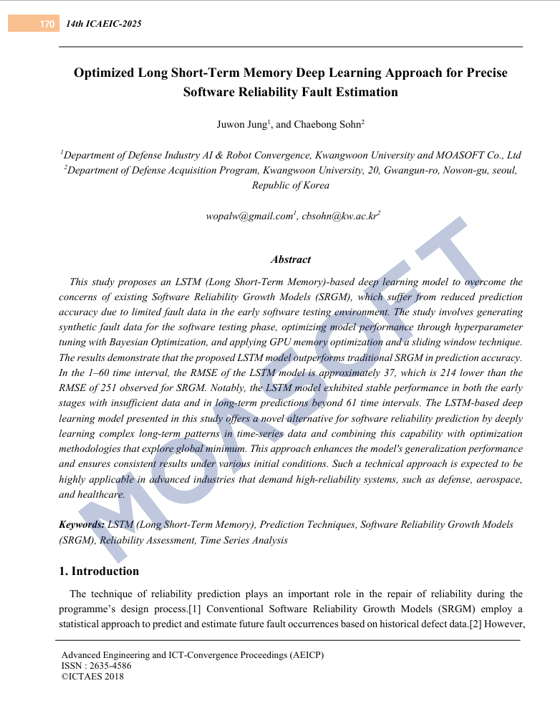
This study proposes an LSTM (Long Short-Term Memory)-based deep learning model.
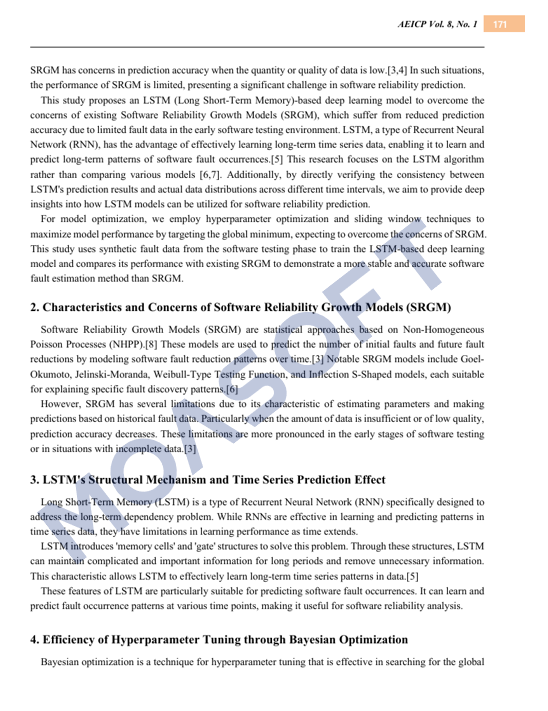
This model is designed to overcome the concerns of existing Software Reliability Growth Models (SRGM).
These models suffer from reduced prediction accuracy due to limited fault data in the early software testing environment.
which suffer from reduced prediction accuracy due to limited fault data in the early software testing environment.
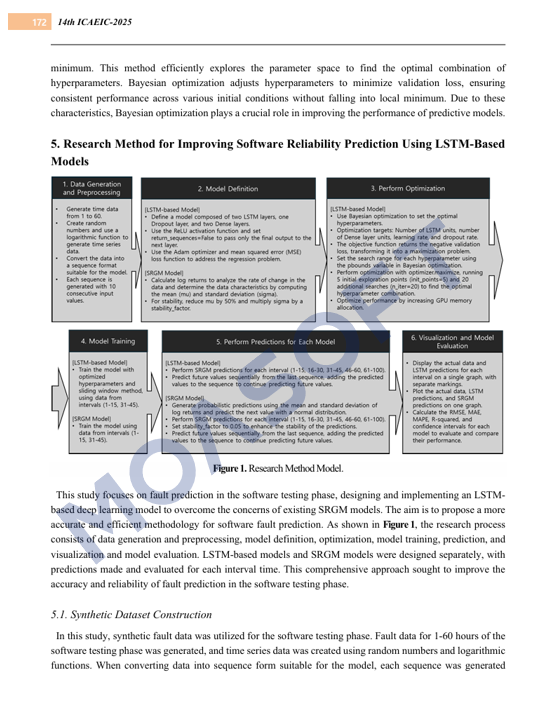
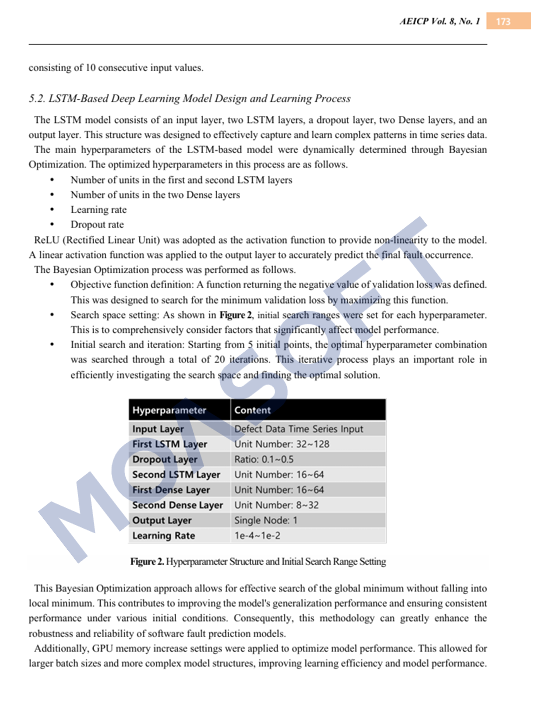
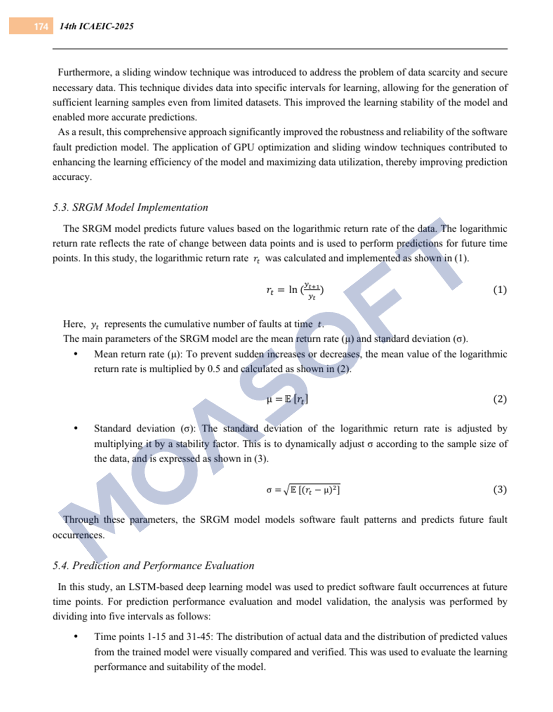
The study involves generating synthetic fault data for the software testing phase, optimizing model performance through hyperparameter tuning with Bayesian Optimization and applying GPU memory optimization and a sliding window technique.
The results demonstrate that the proposed LSTM model outperforms traditional SRGM in prediction accuracy.
In the 1–60 time interval, the RMSE of the LSTM model is approximately 37, which is 214 lower than the
RMSE of 251 observed for SRGM. Notably, the LSTM model exhibited stable performance in both the early
stages with insufficient data and in long-term predictions beyond 61 time intervals.
The LSTM-based deep learning model presented in this study offers a novel alternative for software reliability prediction by deeply learning complex long-term patterns in time-series data and combining this capability with optimization
methodologies that explore global minimum.
This approach enhances the model’s generalization performance and ensures consistent results under various initial conditions.
Such a technical approach is expected to be highly applicable in advanced industries that demand high-reliability systems, such as defense, aerospace and healthcare.
[번역본]
본 연구는 LSTM(Long Short-Term Memory) 기반 딥러닝 모델을 제안한다.
이 모델은 기존 소프트웨어 신뢰성 성장 모델(SRGM)이 가진 문제점을 극복하기 위해 설계되었다. 기존 SRGM은 초기 소프트웨어 테스트 환경에서 결함 데이터가 제한적이기 때문에 예측 정확도가 떨어지는 한계를 가지고 있다.
본 연구는 소프트웨어 테스트 단계를 위한 합성 결함 데이터를 생성하고, 베이지안 최적화(Bayesian Optimization)를 활용한 하이퍼파라미터 튜닝을 통해 모델 성능을 최적화하였다. 또한 GPU 메모리 최적화와 슬라이딩 윈도우(sliding window) 기법을 적용하였다.
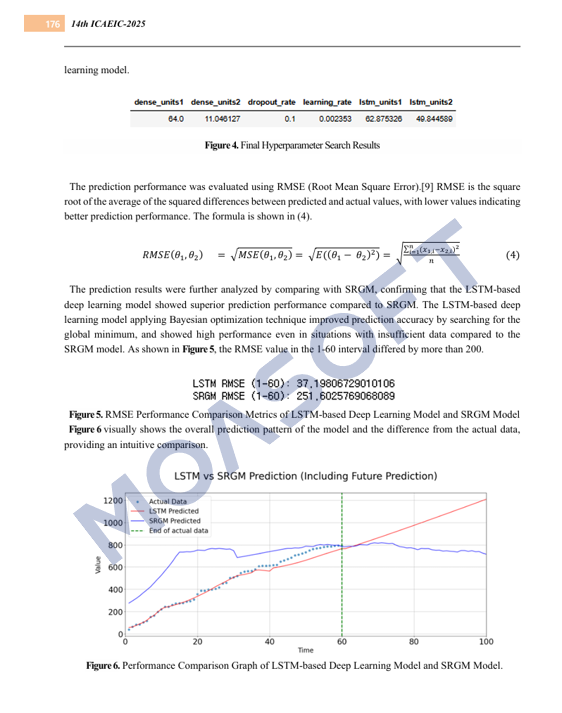
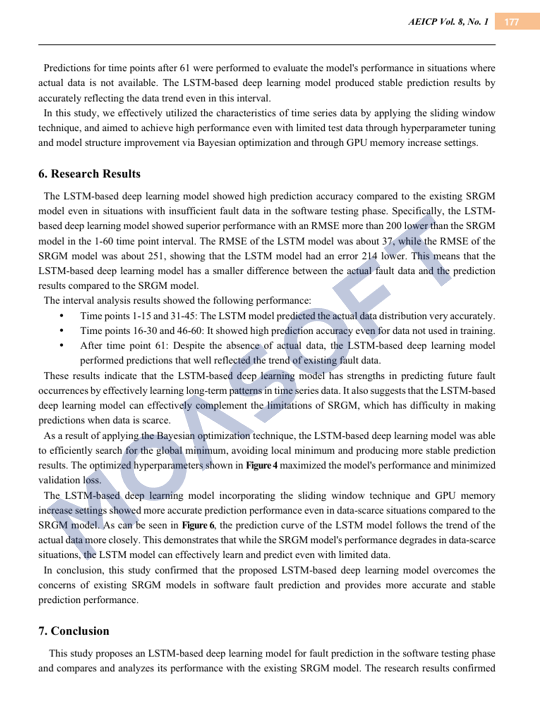
연구 결과, 제안된 LSTM 모델이 예측 정확도 면에서 기존 SRGM보다 우수한 성능을 보이는 것으로 나타났다. 1~60 구간에서 LSTM 모델의 RMSE는 약 37로, SRGM에서 관측된 RMSE 251보다 214 낮은 수치였다.
특히 LSTM 모델은 데이터가 부족한 초기 단계와 61 구간 이후의 장기 예측 구간 모두에서 안정적인 성능을 보였다.
본 연구에서 제시한 LSTM 기반 딥러닝 모델은 시계열 데이터의 복잡한 장기 패턴을 깊이 학습함으로써 소프트웨어 신뢰성 예측의 새로운 대안을 제시한다. 이러한 학습 능력은 전역 최솟값(global minimum)을 탐색하는 최적화 방법론과 결합되었다.
이러한 접근 방식은 모델의 일반화 성능을 향상시키고, 다양한 초기 조건에서도 일관된 결과를 보장한다. 이러한 기술적 접근은 국방, 항공우주, 헬스케어와 같이 높은 신뢰성이 요구되는 첨단 산업 분야에서 높은 활용 가능성을 가질 것으로 기대된다.
…중략…
결론
[원문 (영문)]
This study proposes an LSTM-based deep learning model for fault prediction in the software testing phase and compares and analyzes its performance with the existing SRGM model.
The research results confirmed that the LSTM-based model demonstrated superior prediction accuracy compared to traditional SRGM, even in situations with limited fault data. Key findings of this study are as follows.
Prediction Accuracy
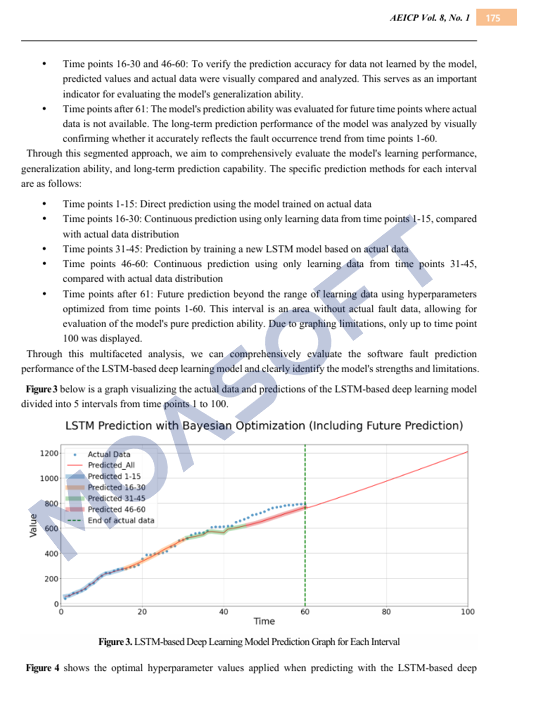
The LSTM model achieved higher prediction accuracy, demonstrating an RMSE 214 lower than the SRGM model in the 1-60 time interval.
Response to Data Scarcity
Even in environments with limited data, the LSTM model exhibited more stable and accurate predictive performance compared to the SRGM model.
Long-term Prediction Capability
The LSTM model effectively predicted trends reflecting existing fault data, even in intervals beyond the 61st time point where actual data was unavailable.
Model Optimization
Model performance was maximized through hyperparameter tuning using Bayesian optimization techniques.
Data Utilization Efficiency
The application of the sliding window technique and GPU memory increase enabled effective learning even with limited datasets.
These results suggest that the LSTM-based deep learning model has significant advantages in learning long term and complicated patterns of time series data and predicting future fault occurrences in software reliability analysis.
The model effectively complements the concerns of SRGM, particularly in situations where data is scarce or incomplete.
These results suggest that LSTM-based deep learning models can overcome the concerns of existing SRGM models in the field of software fault prediction, providing more accurate and stable predictions.
The LSTM model is particularly effective in situations with limited data or when long-term predictions are required.
Future research could further generalize these findings by validating the results using data from various real software projects and conducting comparative analyses with other deep learning models.
Additionally, research into methods for improving model interpretability and providing reliability measures for prediction results is necessary.
In conclusion, the LSTM-based deep learning model proposed in this study presents new possibilities in the field of software reliability prediction.
It is expected to be particularly useful in areas requiring high reliability, such as the defense industry.
[번역본]
본 연구는 소프트웨어 테스트 단계에서의 결함 예측을 위해 LSTM 기반 딥러닝 모델을 제안하고, 기존 SRGM 모델과 성능을 비교·분석하였다.
연구 결과, 결함 데이터가 제한적인 상황에서도 LSTM 기반 모델이 기존 SRGM보다 우수한 예측 정확도를 보이는 것으로 확인되었다.
본 연구의 주요 결과는 다음과 같다.
예측 정확도
LSTM 모델은 1~60 구간에서 SRGM 모델보다 RMSE가 214 낮은 수치를 보이며 더 높은 예측 정확도를 달성하였다.
데이터 부족에 대한 대응력
데이터가 제한적인 환경에서도 LSTM 모델은 SRGM 모델보다 더 안정적이고 정확한 예측 성능을 보였다.
장기 예측 능력
LSTM 모델은 실제 데이터가 존재하지 않는 61번째 구간 이후에도 기존 결함 데이터를 반영한 추세를 효과적으로 예측하였다.
모델 최적화
베이지안 최적화 기법을 활용한 하이퍼파라미터 튜닝을 통해 모델 성능이 극대화되었다.
데이터 활용 효율성
슬라이딩 윈도우 기법과 GPU 메모리 증대를 적용함으로써 제한된 데이터셋에서도 효과적인 학습이 가능하였다.
이러한 결과는 LSTM 기반 딥러닝 모델이 시계열 데이터의 장기적이고 복잡한 패턴을 학습하고, 소프트웨어 신뢰성 분석에서 향후 결함 발생을 예측하는 데 있어 상당한 이점을 가진다는 것을 시사한다.
이 모델은 특히 데이터가 부족하거나 불완전한 상황에서 SRGM의 한계를 효과적으로 보완한다.
이러한 결과는 LSTM 기반 딥러닝 모델이 소프트웨어 결함 예측 분야에서 기존 SRGM 모델의 한계를 극복하고, 더 정확하고 안정적인 예측을 제공할 수 있음을 시사한다.
LSTM 모델은 특히 데이터가 제한적이거나 장기 예측이 필요한 상황에서 효과적이다.
향후 연구에서는 다양한 실제 소프트웨어 프로젝트의 데이터를 활용해 본 연구 결과를 검증하고, 다른 딥러닝 모델과의 비교 분석을 수행함으로써 이러한 결과를 더욱 일반화할 수 있을 것이다.
또한 모델의 해석 가능성을 개선하고 예측 결과에 대한 신뢰도 지표를 제공하는 방법에 대한 연구도 필요하다.
결론적으로, 본 연구에서 제안한 LSTM 기반 딥러닝 모델은 소프트웨어 신뢰성 예측 분야에서 새로운 가능성을 제시한다.
이 모델은 국방 산업과 같이 높은 신뢰성이 요구되는 분야에서 특히 유용할 것으로 기대된다.
![LSTM 기반 소프트웨어 신뢰성 예측 연구 참고문헌 목록 [15]~[23]](https://moasoftware.co.kr/wp-content/uploads/2025/07/optimized-long-short-term-memory-deep-learning-approach-for-precise-software-reliability-fault-estimation-10.png)
• 해당 논문은 14th ICAEIC-2025 에서 발표되었습니다.
국방무기체계 SW ALM 도구 관련 문의
- 대표 문의: 02-420-3203
- 홈페이지: 기술 문의하기